
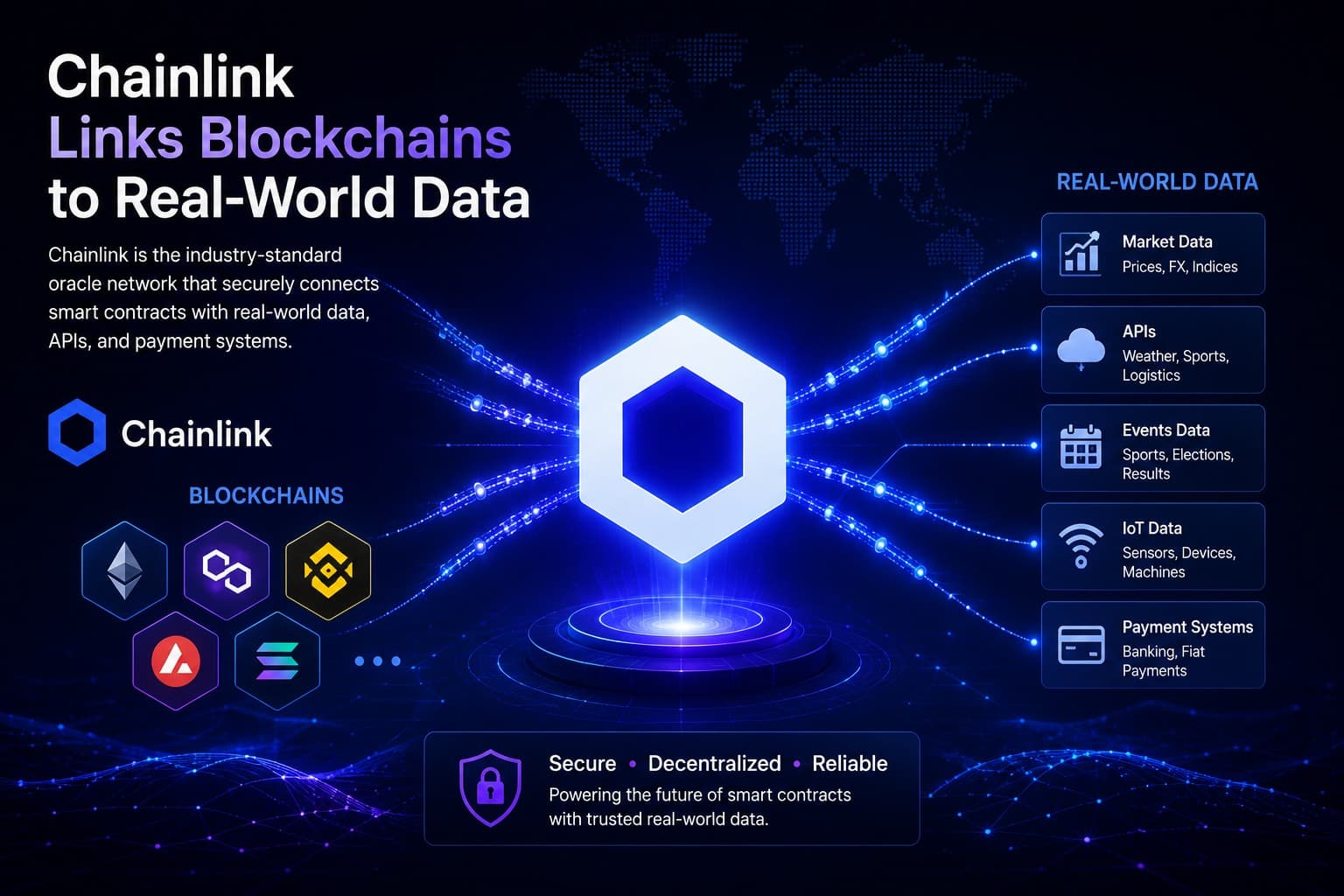
Blockchains are powerful at recording and verifying transactions, but on their own they are isolated. A smart contract cannot check a stock price, confirm a bank balance, or read data from another chain without outside help. This is known in the industry as the "oracle problem," and it has stood as one of the biggest barriers to bringing real-world finance onchain.
https://x.com/chainlink/status/2074148952723632133?s=20
On July 6, 2026, Chainlink summarized this challenge and its answer in a single post on X: blockchains cannot connect to the real world on their own, so Chainlink links them to existing systems and data, with the outcome being global finance moving onchain. It is a simple framing, but it captures why the Chainlink oracle network has become foundational infrastructure for decentralized finance (DeFi) and, increasingly, for traditional financial institutions experimenting with tokenization.
The Problem: Blockchains Are Isolated By Design
Blockchains are intentionally closed systems. Their security comes from consensus among network participants who can only agree on data that lives inside the chain itself. That design keeps the ledger tamper-resistant, but it also means smart contracts have no native way to pull in external information such as asset prices, weather data, sports results, or messages from another blockchain.
Without a secure bridge to outside data, decentralized applications would be limited to simple, self-contained functions. Lending platforms could not use live collateral prices. Insurance contracts could not verify real-world events. Tokenized stocks or bonds could not track their underlying asset. This gap between onchain logic and offchain reality is what the industry calls the oracle problem, and it is the starting point for understanding why the Chainlink oracle network exists.
The Solution: A Decentralized Bridge To Offchain Systems
Chainlink's answer is a decentralized oracle network that retrieves, verifies, and delivers external data to smart contracts across many blockchains. Rather than relying on a single data source, which would reintroduce the very trust assumptions blockchains are meant to avoid, Chainlink aggregates information from multiple independent node operators before it reaches a smart contract.
Over time, this core function has expanded into a broader suite of services. Chainlink Data Feeds and Data Streams deliver price data to DeFi protocols. Chainlink Automation triggers smart contract functions based on predefined conditions. Chainlink Functions allows contracts to request custom offchain computation. And the Cross-Chain Interoperability Protocol (CCIP) lets tokens and messages move securely between different blockchain networks, addressing not just the "real world to blockchain" gap but also the "blockchain to blockchain" one.
According to data from CoinGecko, the network is widely regarded as the market leader in bringing real-world data onchain and is considered one of the first decentralized oracle networks built for this purpose. That early positioning has translated into scale: Chainlink's infrastructure now secures the large majority of total value locked across DeFi and has supported tens of trillions of dollars in transaction value since launch.
The Outcome: Institutions Are Building On Chainlink
The clearest evidence that this problem-solution framing is playing out in practice comes from a wave of institutional integrations in 2026. Robinhood's new Ethereum layer-2 network, Robinhood Chain, launched with Chainlink as its official oracle and cross-chain infrastructure provider, using CCIP and Data Feeds to support tokenized stock products including shares tied to Nvidia, Google, and Apple.
Fidelity International's tokenized digital liquidity fund, FILQ, uses the Chainlink Runtime Environment to publish its net asset value onchain, enabling round-the-clock treasury and collateral operations for institutional users. Europe's largest tokenized money market fund, operated by Spiko, has taken a similar approach on Solana. Meanwhile, the Depository Trust & Clearing Corporation (DTCC), the world's largest securities clearinghouse, is integrating Chainlink's Runtime Environment into its Collateral AppChain, with production targeted for later in 2026.
These deployments sit alongside a longer list of enterprise names that have adopted Chainlink standards, including Swift, Euroclear, Mastercard, UBS, and ANZ. In May 2026, Deloitte completed a SOC 2 Type 2 examination of Chainlink's CCIP and Data Feeds, a compliance milestone that matters for institutions weighing whether to trust public blockchain infrastructure with regulated activity.
Expert Opinions: What Industry Voices Are Saying
Chainlink Labs executives have been direct about what these integrations represent for the broader market. Thodoris Karakostas, Director of Global Partnerships at Chainlink Labs, described the Robinhood Chain launch as an example of how the world's largest financial services apps are accelerating the shift to an onchain financial system built on Chainlink infrastructure. On the Robinhood side, Gaëtan Thabot, Director of Product at Robinhood Crypto, said the company selected Chainlink specifically because its institutional-grade security and reliability are already trusted by major financial institutions working to scale onchain ecosystems.
Market analysts have also weighed in on the disconnect between this adoption and the LINK token's price action. Multiple 2026 market reports note that Chainlink's ecosystem now includes thousands of active projects, and that CCIP transfer volume has grown sharply quarter-over-quarter, even as LINK has traded well below earlier-year highs. That divergence has fueled debate among traders about whether network utility will eventually be reflected in the token's valuation, though price forecasting remains speculative and should not be treated as financial advice.
Why The Oracle Problem Still Matters In 2026
Even with years of development behind it, the underlying challenge Chainlink was built to solve has not disappeared — if anything, it has grown more consequential as tokenized real-world assets move from pilot programs to production systems. A tokenized bond, fund, or stock is only as trustworthy as the data connecting it to its real-world counterpart. If that data feed is manipulated, delayed, or centralized in a single point of failure, the entire onchain representation loses credibility.
This is why the Chainlink oracle network has positioned itself less as a single product and more as a piece of financial market infrastructure, comparable in function to the data and settlement layers that traditional finance has relied on for decades. The addition of compliance tooling, cross-chain messaging, and offchain computation reflects an attempt to meet the operational requirements that banks, asset managers, and clearinghouses expect before committing significant capital.
The Bigger Picture
The July 6 post from Chainlink distills a multi-year buildout into three steps: identify that blockchains are cut off from the outside world, connect them securely to that outside world, and use that connection to move real financial activity onchain. The projects launching in mid-2026, from Robinhood Chain to Fidelity's tokenized fund to DTCC's collateral system, suggest that the third step is no longer theoretical.
Whether this translates into sustained price performance for LINK is a separate question from whether the underlying technology is being used. For now, the data points to continued expansion of the Chainlink oracle network across both crypto-native platforms and legacy financial institutions, reinforcing its role as one of the more closely watched pieces of infrastructure in the tokenization trend.
This article is for informational purposes only and does not constitute financial advice. Cryptocurrency markets are volatile; always do your own research before making investment decisions.